
K-Rend Cleaning
K-rend cleaning, done properly. Softwash specialists who understand how K-rend is made, why it stains, and — most importantly — how to clean it without ruining it.
What is K-Rend and how is it cleaned?
K-rend is one of the best modern render systems on the market. It’s also one of the easiest to damage if you clean it the wrong way. Every year we get called out to homes across the Midlands where someone has tried to pressure-wash a stained K-rend wall and made it permanently worse. At Modus Softwashing we specialise in K-rend cleaning the right way — a low-pressure softwash process using manufacturer-approved chemistry, applied by a City & Guilds-qualified technician with 13+ years of experience. No damage. No wash marks. No voided warranties. Just clean K-rend.


What K-Rend Actually Is
and why it stains so visibly ...
K-rend is a silicone-based, through-coloured render manufactured by Kilwaughter Minerals in Northern Ireland. It’s been on the UK market since the early 2000s and has become the dominant render finish on new-build properties — particularly across the Midlands new-build belt.
Three things make K-rend genuinely different from older render systems:
- The colour runs all the way through the coating. Unlike traditional sand-and-cement render that gets painted on top, K-rend’s colour is in the material. That’s why it doesn’t need repainting — but it’s also why surface damage is so visible.
- The render is relatively thin — typically around 6–10mm of K-rend on top of a basecoat. There’s not much depth to play with if you damage the surface.
- The silicone content makes it water-repellent. That’s mostly a good thing — rain runs off rather than soaking in. But it also means that when algae and pollutants land on the surface, they sit there rather than washing away naturally with rainfall.
This last point is why K-rend often looks dirtier, faster, than traditional render — particularly the lighter colour options (white, ivory, magnolia). It’s not that K-rend gets dirtier than other surfaces. It’s that the dirt is more visible against the light colour and the water-repellent surface holds it more obviously.
Why K-Rend Stains
Why K-Rend Stains: The Four Things That Actually Cause It
Almost every dirty K-rend wall we’re called to has a combination of these four staining causes. Knowing which one — or which combination — is on your property is the first step to cleaning it properly.
Green algae (single-cell algae) The most common cause. Tiny single-cell algae land on the render as airborne spores and colonise the surface, particularly on north and east-facing walls that stay damp longer. Shows as a uniform green tint, often worst at the base of walls and around downpipes.
Red algae (Trentepohlia) A particular nuisance on K-rend. Despite the name, it’s actually a green algae that produces orange-red pigments. Shows as red, orange or rust-coloured patches — and it’s increasingly common across the Midlands as our climate gets milder. Homeowners often mistake it for rust marks or render failure when it’s neither.
Black mould and lichen (Geocapsa magma, Aspergillus niger, lichen species) The black, dark grey and patchy growths that often appear beneath windows, under guttering and at parapet level. These are mixed fungal and lichen colonies that get into the porosity of the render. They’re tougher to shift than algae and need a stronger softwash mix.
Pollution and atmospheric grime Diesel particulates, rubber dust from road traffic, and general airborne grime that settles on the silicone-rich surface. Particularly visible on properties near busy roads, motorway corridors and along the rail commuter lines. Pollution staining often bonds with the algae, creating a darker, more stubborn film than either would produce alone.
A proper K-rend clean has to identify which combination is on your property and adjust the softwash mix accordingly. A one-size-fits-all approach rarely produces the best result.
Why Jet Washing K-Rend Is the Wrong Answer
Why You Should Never Pressure-Wash K-Rend
This is the single most important point on this page. If you take nothing else away, take this:
A pressure washer will damage K-rend. Not might, not sometimes, not unless you’re careful — it will.
Here’s why. K-rend’s silicone-rich surface is what gives it its colour, its water-repellency and its ability to weather without fading for decades. High-pressure water — even at what feels like a moderate setting — strips that surface layer unevenly. Underneath is a paler, more matte, more absorbent layer that wasn’t designed to be exposed.
The result is visible to the naked eye:
- Patchy fading where the surface layer has been thinned in some areas more than others
- Wash marks showing the exact path the operator took with the lance
- Loss of water-repellency in stripped areas, which then absorb water faster, encourage more algae growth, and start the staining cycle worse than before
- In severe cases, “blown” render where pressure has forced water behind the K-rend and lifted it from the basecoat — which is a re-render job
And critically: none of this is reversible. Once K-rend’s surface has been stripped, the only fix is to take it off and re-render. On a typical new-build detached property, that’s a five-figure repair bill.
There’s also the warranty issue. K-rend’s manufacturer, Kilwaughter Minerals, has specific guidance on cleaning that prohibits high-pressure water and the use of unapproved chemistry. Using a pressure-wash contractor — even one who’s confident — risks voiding any remaining manufacturer warranty on the render.
The honest reality: softwashing is the only safe method. Pressure washing K-rend is never the right answer, regardless of how stubborn the staining looks.
The Right Way
The Right Way: Softwashing K-Rend
Softwashing is the manufacturer-recommended method for cleaning K-rend, and it’s the only method we use.
Here’s what it actually involves:
1. Site survey and assessment. Before any chemistry goes near your render, we identify the K-rend product (Kilwaughter make several variants — K1, Silicone TC, HP12 and others, each with slightly different surface characteristics), assess the staining type and depth, check access, and identify any complicating factors like adjacent landscaping, neighbouring properties, or windows that need protection.
2. Tailored softwash mix. The biocide concentration is calibrated to the staining type. Light surface algae needs a different mix than 8-year-old bonded black mould. We err on the side of starting weaker and adding strength only if needed — over-strong chemistry can leave residue that affects the render’s appearance.
3. Low-pressure application. Professional softwash equipment, applied at pressures of typically 30–50 PSI — roughly the pressure of a domestic garden hose, and a fraction of even a low-power pressure washer (which typically operates at 1,200–2,000 PSI). No mechanical force ever touches the render.
4. Dwell time. The biocide is allowed to work, typically 30–60 minutes. This is the bit most DIY attempts get wrong — pressure washing tries to blast the algae off mechanically, but softwashing kills it chemically at the spore level. The dwell stage is what produces the long-lasting result.
5. Rinse and finish. Where appropriate, a gentle clean-water rinse. With many softwash treatments on K-rend, the render continues to brighten over the following days and even weeks as the biocide finishes its work and the dead algae weathers off naturally.
6. Aftercare. Honest advice on when you’ll need it doing again — typically every 3–5 years on K-rend, sooner for properties on north-facing aspects, shaded by trees, or near busy roads.
What We Can and Can't Fix
What K-Rend Cleaning Can and Can't Fix — An Honest Look
Most softwashing companies will tell you they can clean anything. We’d rather be straight with you.
What softwashing fixes well:
- Green algae and Trentepohlia (red algae) — almost always restored to near-new condition
- Black mould, lichen and fungal staining — usually fully cleared, occasionally needing a second visit on heavy build-up
- Pollution staining — generally clears well, may need a stronger detergent stage on heavily-bonded grime
- Light surface dirt and general weathering — straightforward
What softwashing partially fixes:
- Mineral / efflorescence staining — the white crystalline deposits that sometimes appear on K-rend, particularly in the first 1–2 years after installation. These are leached salts from the substrate, not surface dirt. They often improve with cleaning but may not fully clear on the first visit.
- Embedded ingrained dirt on very old, unmaintained K-rend — generally clears, but a 12-year-old uncleaned wall may need two visits.
What softwashing can’t fix:
- Previous pressure-wash damage — patchy fading, wash marks, blown sections. As covered above, this is permanent. We can clean the surrounding areas but we can’t reverse the damage.
- Cracking or render failure — softwashing is a cleaning treatment, not a repair. If your K-rend is cracked, debonding from the substrate, or showing signs of failure, you need a render specialist for repair work first.
- Colour fading from UV exposure — rare but does occur on very old K-rend installations. Cleaning won’t restore lost pigment.
If we come to survey and find any of the unfixable issues above, we’ll tell you honestly and recommend what to do next — even if that means we don’t get the cleaning job. That’s how we’d want to be treated, and it’s how we work
Other Renders We Clean
"Is It K-Rend, or Is It Something Else?"
K-rend is a brand name, but there are several similar through-coloured renders on the market — and homeowners often refer to all of them as “K-rend” colloquially. We clean all of them, with the same safe softwash method:
- Genuine K-rend (Kilwaughter Minerals — K1, Silicone TC, HP12 and other variants)
- Parex silicone-mineral renders
- Weber through-coloured silicone renders
- Sto render systems (StoSilco, StoLotusan and others)
- Wetherby silicone renders
- Baumit silicone and silicate renders
- Monocouche single-coat through-coloured renders (Parex, Weber, Webertherm and others)
If you’re not sure which product is on your property, the survey will identify it. The cleaning method is essentially the same for all of them — low pressure, manufacturer-safe biocide — but we adjust the chemistry slightly for each.
How Often Should K-Rend Be Cleaned?
There isn’t a single right answer — it depends on the property — but here’s a working framework:
First clean: around 5–7 years from installation, in most cases. Earlier (3–4 years) on:
- North or east-facing properties
- Properties heavily shaded by trees or neighbouring buildings
- Properties on or near busy roads (pollution staining accelerates)
- Coastal or river-valley properties with persistently damp air
Subsequent cleans: every 3–5 years thereafter. Some properties stretch to 6–7 years comfortably; others need attention every 2–3 years.
Signs it’s time:
- Visible green tint, particularly at the base of walls or around downpipes
- Black streaking beneath windows or at parapet level
- Red or rust-coloured patches anywhere on the render
- General “dirty” appearance, even after rainfall (rain alone doesn’t clean modern render — that’s the silicone water-repellency working as designed)
If you’re not sure, a free survey will tell you whether your render genuinely needs cleaning yet or whether you can comfortably wait another year or two. We’d rather give you honest advice than create an unnecessary job.
Where We Cover
We’re a Staffordshire-based K-rend cleaning specialist, covering homes and businesses across the Midlands. Most of our K-rend work is on residential properties — particularly new-build estates from the 1990s onwards — though we also work on commercial buildings, schools and apartment blocks.
We cover K-rend cleaning across:
- Lichfield
- Burntwood
- Tamworth
- Rugeley
- Sutton Coldfield — including Walmley, Minworth, Four Oaks and Mere Green new-build estates
- Staffordshire
- West Midlands
Larger commercial K-rend jobs further afield are considered on a case-by-case basis. Call or email to discuss.
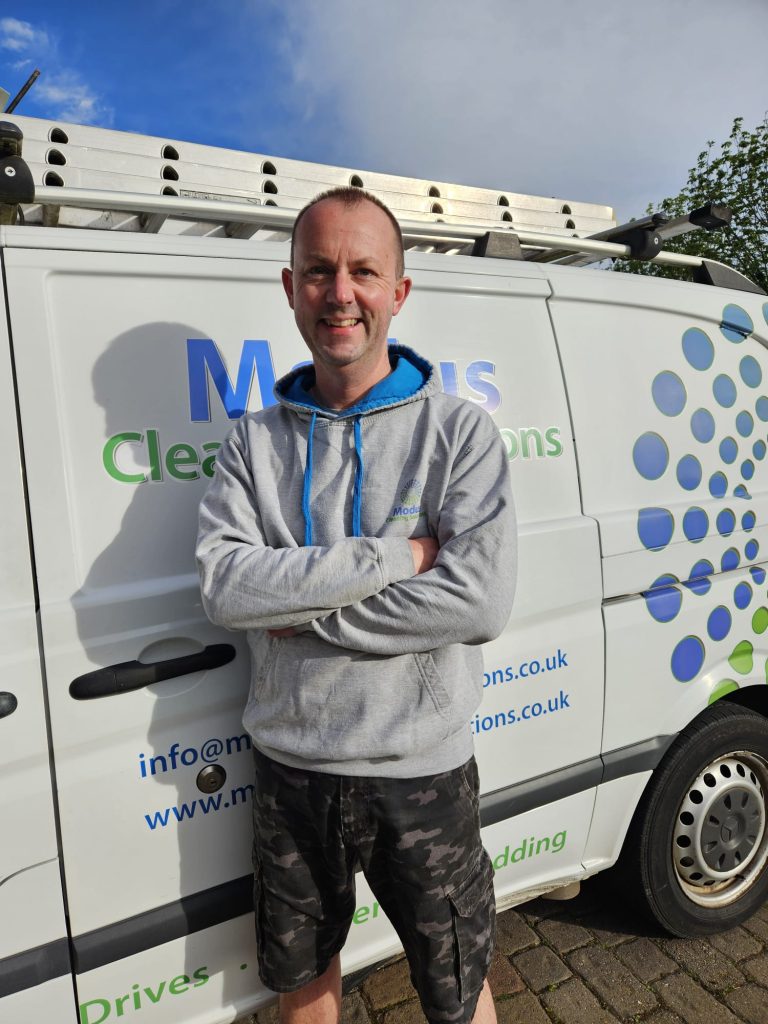
Why Choose Modus for K-Rend Cleaning
- A K-rend specialist, not a generalist. This is our daily work — not something added to a list of unrelated services.
- Properly qualified. Our founder Steven Mallaber is a City & Guilds-certified Professional Softwashing Technician with a BSc in Building Surveying & The Environment and an MA in Architectural Conservation. The building science background matters when you’re cleaning a surface that can be permanently damaged by getting it wrong.
- 13+ years of softwash experience specifically on render systems — not a general pressure-washing operator who’s added K-rend to the menu.
- Manufacturer-safe chemistry and methods — nothing we use will void a Kilwaughter warranty or compromise the render’s surface.
- Fully insured for residential and commercial work.
- Honest about limits. If your render can’t be fully restored, we’ll tell you upfront rather than overselling.
Watch us in action!
Patio Cleaning
Render Cleaning
Request a Quote
Learn More From
K-Rend Cleaning Frequently Asked Questions
Kilwaughter’s own guidance technically allows a low-pressure fan setting in some circumstances, but in practice almost every professional softwasher will tell you not to risk it. The margin between “safe pressure” and “damaging pressure” is small, hard to judge by feel, and varies with the age and condition of the render. Softwashing is the safer answer in every situation.
Only if the wrong methods or chemistry are used. Softwashing with manufacturer-safe biocide and low pressure is the recommended approach and will not affect a Kilwaughter warranty. Using harsh acids, high-pressure water, or unapproved cleaning products may void warranty cover.
The cost depends on the size of the property, the level and type of staining, and access. Most domestic K-rend cleans fall within a typical range — we provide a firm written quote after a free site survey.
Not necessarily. Some properties show early staining well before the 5-year mark, particularly on north-facing or shaded elevations. If you can see it, it’s worth at least a survey. Early intervention is much easier and cheaper than waiting for heavy build-up.
Yes — most domestic two- and three-storey properties are cleaned safely from the ground using extending equipment. Larger commercial buildings may require additional access arrangements; we’ll discuss this at the survey.
Yes. We use eco-friendly biocides that break down quickly in the environment. We cover delicate planting before treatment and advise on keeping pets indoors during application. Children can return to the property as normal once the surface is dry.
In most cases, yes — sometimes dramatically. The exception is if the render has previously been damaged by pressure washing (which strips the surface and is irreversible) or if there’s UV fading on very old installations.
We can apply a post-clean biocide treatment that extends the time before re-cleaning is needed — particularly worth considering on heavily shaded or exposed properties. We’ll discuss this at the survey if it’s likely to be useful.