
Render Cleaning Stafford
Specialist softwash render cleaning across Staffordshire’s county town – from the Victorian railway housing of Castletown and Doxey, to the post-war estates of Highfields and Risingbrook, and the new K-rend developments at Burleyfields and beyond.
Get your free Stafford render cleaning quote.
Low Pressure Render Cleaning Specialists.
Stafford is the most varied town we cover when it comes to render – and probably the most challenging environment for it. The M6 runs along the eastern edge of the town, Doxey Marshes wetland reserve sits on the western edge, and the housing stock spans 150 years from Victorian railway-worker terraces through inter-war suburban semis, post-war council estates and right up to today’s K-rend new-builds at Burleyfields. At Modus Softwashing, we’re based in Handsacre – around 20 minutes south of Stafford via the A513 – and we’ve cleaned render across every part of the borough for over 13 years. We use a specialist low-pressure softwash system that’s safe on every type of render, including K-rend, monocouche and the painted sand-and-cement finishes common across Stafford’s older estates.


Why Stafford Render Gets Dirty
Why Render in Stafford Faces the Toughest Conditions in the County
Stafford has a combination of environmental and atmospheric pressures on render that you genuinely don’t find together anywhere else in Staffordshire. Three of them really matter:
1. The M6 corridor. The motorway runs along the eastern edge of the town between Junctions 13 (Stafford South) and 14 (Stafford North), and the A449 carries heavy traffic north–south straight through the borough. Diesel particulates, brake dust and tyre wear settle on rendered walls and bond with the algae beneath, producing the dark grey-black film that’s particularly visible on properties across Baswich, Weeping Cross, Walton, Wildwood and the Stafford Common side of town. This is more intense pollution exposure than anywhere else we cover – yes, including the Tamworth M42 corridor.
2. Doxey Marshes and the western damp-air pattern. The 100-hectare RSPB Doxey Marshes nature reserve sits immediately to the west of the town, between Castletown and the Burleyfields development. Damp wetland air drifts east across Doxey, Castletown, parts of Holmcroft, Stafford Common and into the Highfields estates, particularly on still mornings and through the autumn and spring. Properties on this western side typically show heavier green algae growth on their north and west elevations than the same property type would on the east side of town.
3. The most varied housing stock of any town we cover. Stafford has render across an unusually wide span of building eras:
- Victorian railway-worker terraces in Castletown and parts of Doxey, built from the 1860s onwards as the railway industry expanded around Henry Venables’s sawmills and the Bagnall engine works. Mostly painted sand-and-cement render, often unmaintained for decades.
- Inter-war suburban semis across Coton, Forebridge and the older parts of Highfields: 1920s–30s painted render and Tyrolean dash, similar to Sutton Coldfield’s B73 stock.
- Post-war council estates at Manor, Risingbrook, and the two Highfields estates (built mid-1950s and early 1960s), predominantly pebbledash and painted cement render.
- Modern K-rend new-builds at Burleyfields (Taylor Wimpey), the Marston Grange development, and the executive housing across Weeping Cross and Wildwood, through-coloured silicone renders that need careful handling.
Each of these calls for a slightly different softwash approach, and you can’t treat them all the same. The good news: almost all of it cleans up brilliantly with the right method.
What we clean
Render Types We Clean Across Stafford
We’re equipped and qualified to handle every render type found on Stafford properties:
- K-rend, monocouche and silicone-mineral renders — dominant across Burleyfields, Marston Grange, the newer Weeping Cross developments, executive Wildwood properties and most recent builds
- Painted sand-and-cement render – the workhorse finish on Castletown, Doxey, Coton and inter-war Forebridge
- Pebbledash – found extensively across Manor, Risingbrook, Highfields and the post-war estates
- Tyrolean and rough-cast finishes – common on 1920s–30s semis through the older suburban areas
- Traditional render on period property – including the listed and historic stock around the town centre, Eastgate Street, Greengate Street, and the Forebridge conservation area (which has 98 listed buildings)
- Specialist proprietary renders including StoRend, Parex, Weber and Wetherby systems
Not sure what render you’ve got? Not a problem – we’ll identify it at the free survey.
Areas We Cover in Stafford
Surrounding Stafford Borough:
- Stone and Stone Rural (the borough’s second town)
- Eccleshall
- Gnosall and Woodseaves
- Hixon and Haywood
- Milford
- Barlaston
- Yarnfield
- Brocton
- Plus the villages of Gnosall, Hopton, Salt, Sandon, Weston, Ingestre and the broader Stafford Borough rural area
Outside Stafford? We also cover Lichfield, Burntwood, Tamworth, Rugeley, Sutton Coldfield and the wider Staffordshire and West Midlands area.
We carry out render cleaning across the whole of Stafford Borough, including:
- Stafford town centre and Forebridge
- Castletown
- Doxey
- Baswich
- Littleworth
- Highfields and Western Downs (estates 1 and 2)
- Holmcroft
- Manor
- Penkside
- Coton
- Rowley
- St Michael’s and Stonefield
- Weeping Cross and Wildwood
- Walton
- Stafford Common
- Burleyfields and Marston Grange new-builds
Why Softwashing?
Why You Should Never Pressure-Wash Render in Stafford
There’s a particular temptation in Stafford to “go in hard” on render cleaning, partly because of the heavier pollution staining the M6 corridor brings, partly because of the longer history of unmaintained render across the older estates. Don’t.
On the modern K-rend and silicone-mineral renders dominating Burleyfields and the newer estates, high-pressure water strips the surface layer unevenly, leaving permanent wash marks and patchy fading. The colour runs all the way through these renders, so any surface stripping is immediately visible. The only fix is a full re-render, which on a typical Burleyfields detached property runs into five figures.
On the older painted sand-and-cement render found across Castletown, Doxey, Coton and the Highfields estates, high-pressure water strips the paintwork along with the staining, leaving patchy bare cement render that looks worse than what you started with. It also drives moisture behind the render, which on older properties is a recipe for damp problems further down the line.
Softwashing is the right method for both extremes. A specialist, eco-friendly biocide is applied at very low pressure. The solution kills algae, moss, lichen and black mould at the spore level — and it’s particularly effective at lifting the bonded pollution-and-algae film that’s so common on Stafford properties near the M6 and A449 corridors. The render is left undamaged, the kill is at the root rather than just the surface, and the result lasts far longer than any high-pressure blast.
Our Process
How We Clean Render in Stafford
- Free site survey. We visit your Stafford property, identify the render type (which varies more across this town than anywhere else in our coverage), assess the staining — particularly whether there’s bonded pollution staining from the motorway corridor in addition to algae. Check access, and provide a written, no-obligation quote.
- Tailored softwash mix. A Victorian painted render in Castletown needs a different mix than a 6-year-old K-rend on Burleyfields. Heavily pollution-bonded staining near the M6 sometimes needs a stronger detergent stage in addition to the biocide. We adjust accordingly.
- Low-pressure application. Professional softwash equipment. No high-pressure machinery ever touches your render.
- Dwell time. Typically 30–60 minutes for the biocide to work at the root.
- Rinse and finish. Where appropriate, a clean-water rinse. With many softwash treatments, the render continues to brighten over the following days and weeks.
- Aftercare advice. Honest guidance on when you’ll need it doing again; usually 3–5 years across most of Stafford, sometimes sooner for properties immediately adjacent to the M6 corridor or with persistent Doxey Marshes-side damp-air exposure.
Why Trust us?
Why Stafford Homeowners Choose Modus
- Local and dedicated. We’re based in Handsacre, around 20 minutes south of Stafford via the A513, easy reach of any postcode in the borough. We’re a render and softwash specialist, not a general cleaning firm adding render to a long list of services.
- Properly qualified. Our founder Steven Mallaber is a City & Guilds-certified Professional Softwashing Technician with a BSc in Building Surveying & The Environment and an MA in Architectural Conservation. For a town with as wide a span of render eras as Stafford, from Victorian railway terraces through modern K-rend – that depth of qualification genuinely matters.
- 13+ years’ specific experience in render and softwash work and not a general cleaning company doing render on the side.
- Fully insured for residential and commercial properties.
- Honest. If your render isn’t going to clean up well, particularly older properties where the legacy staining is genuinely deeply bonded, or where previous high-pressure cleaning has caused damage then we’ll tell you upfront. We’d rather lose the job than mis-sell.
Before and After
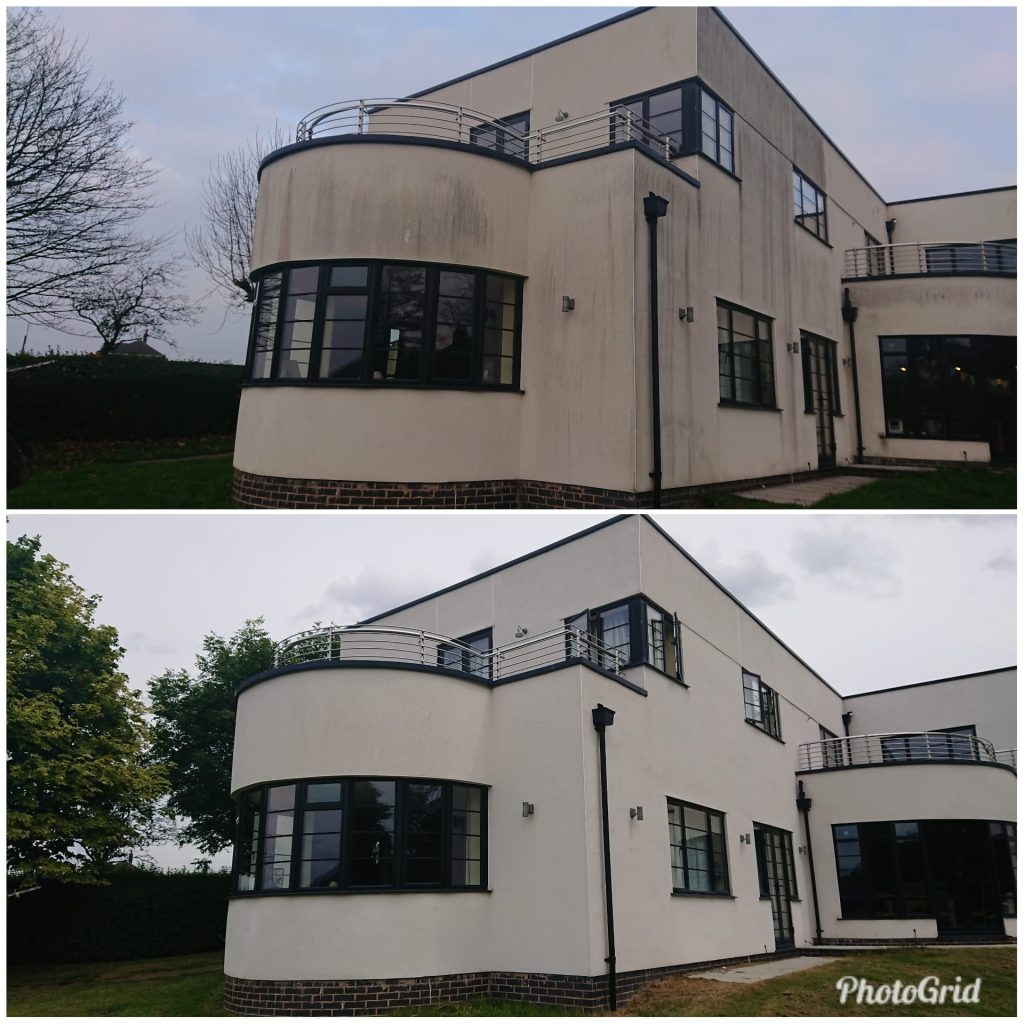
Stafford Render Cleaning - Before & After
Ready to Book Your Stafford Render Clean?
We’ll come out to your Stafford property, give the render an honest assessment, and provide a free, no-obligation written quote.

Contact Us
Learn More From
Render Cleaning Stafford - Common Questions
The cost depends on the size of the property, the render type, and the level and type of staining. Most Stafford domestic render cleans fall within a typical range, and we provide a firm written quote after a free site survey. Call 01543 304 549 to arrange one.
Slightly, yes. Properties near Junctions 13 and 14, along the A449 corridor, and on the eastern side of town generally have more bonded pollution staining on top of the organic growth. We adjust the softwash mix to handle this, often with an additional detergent stage. It’s never a reason not to clean but just something we factor in at the survey.
We usually recommend a first clean around the 5–7 year mark, sooner if you can already see black streaking on the north or windward elevations. Cleaning at this stage is significantly easier and cheaper, than letting it run for another 5 years and dealing with heavily-embedded staining.
Not at all. We clean a lot of long-neglected painted render across Castletown, Doxey and the older parts of Coton. It typically takes a stronger softwash mix and sometimes a second visit, but the results are genuinely transformative. Worth booking a free survey to see what’s realistic.
No. Our process is specifically designed for K-rend and other through-coloured renders, low pressure, manufacturer-safe biocides, no abrasion. It’s pressure washing that damages K-rend, not softwashing.
Yes – Stone is part of Stafford Borough, and we cover the whole borough. We also cover the surrounding villages including Eccleshall, Gnosall, Hixon, Barlaston and the rural areas
Most domestic properties are completed in a single day. Larger detached homes, executive properties on Wildwood and Weeping Cross, and commercial buildings may take longer however we’ll set out a clear timescale with the quote.
Yes. The biocides we use are eco-friendly and break down quickly in the environment. We cover delicate planting before treatment and advise on keeping pets indoors during application.